The intro of this song is accompanied by the guitar bass and piano playing fifths. I wanted to understand what fifths were more so I did some research. I understand it now as closely related pitches and key tones. Musicians such a Wes help us understand something like fifths by showing us these relationships in their music. The chorus of the song is repeated and Wes then shows us his real skills by beginning a Guitar solo. I think Wes loves using Arpeggios in his Solos. My friend Patrick plays Jazz guitar and also loves using Arpeggios in his solos. The tune gets very cool when the Piano begins its solo. The piano solo is then followed by a Bass solo! I think it's so amazing how all three main instruments have their own solo. It really makes you appreciate each player and really shows you just how much talent each musician has. Most the time if a Bass player is just keeping a rhythm I don't realize how much talent one might have. I like Jazz that incorporates all instruments for solos I have decided. The chorus of the song returns and then Wes gives us a little more taste of his genius as a solo musician. In conclusion, this was probably in my top 3 favorite songs I have listened to this semester it helps me to realize just how much I have actually learned!
Sunday, April 29, 2012

Tal Farlow

This North Carolina native was kind of a late bloomer on the guitar, but quickly became a professional, and got his first break with Marjorie Hyams, the great woman vibraphonist in George Shearing's first quintet. He became well-known due to his association with Red Norvo and Charles Mingus in the late 40s and early 50s. After a run with Artie Shaw's famous small group, the Gramercy Five, he formed his own group. In 1958, he went to work as a sign painter and just played in his spare time on local gigs, making only one record as a leader for fifteen years. He came back on the scene some more in the 70s and 80s, and made a number of albums for Concord late in his career and did some touring in England before his death in 1998 from cancer. Although he chose to spend much of his life in relative obscurity, and many of his recordings are hard to find, Tal Farlow's work has been very influential for many younger jazz guitarists.
References: http://waer.org/25guitarists.html
Sunday, April 22, 2012
Critical Listening 11
I thought this would be a good choice after hearing the Latin Jazz Band play last week. You can hear a lot of the instruments that the latin jazz band used such as the cow bell, and latin percussion instruments. The First Chorus starts with the A Section and consists of 4 bars. Horns come in and play the first phrase. There are a series of funny shouts buy the male vocalist. The melody is repeated again with 4 bars of A and and you can hear the vocalist laugh. The Bridge is then played with 8 bars of B by the horns and then the horns play the opening melody one more time. A4, A4, B8, is repeated in the 2nd Chorus with vocalist both male and female making appearances. There is a Trumpet solo in the 3rd Chorus and the 4th chorus is A4A4B8 as well.
Ed Bickert
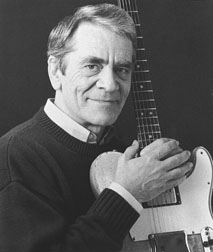
Ed Bickert was born in 1932, in Manitoba, Canada and is recognized as one of Canada's premier jazz guitarists. After his arrival in Toronto in the 1950's he quickly became popular as a studio and session player. After twenty years of steady contribution to the jazz scene in Toronto he was finally exposed to American audiences. When Paul Desmond accepted a show at Bourbon Street, a Toronto nightspot, guitarist Jim Hall recommended that he sign on Bickert as part of his rhythm section. Desmond was so impressed with Bickert's playing that he used him on his next recording, Pure Desmond. That recording exposed Ed Bickert to a broader American audience and started a lot of US based recordings that continue today. What Paul Desmond discovered in Ed Bickert's playing in 1974 was a very full, chordal style that caused him to, "Turn around several times a night to count the strings on his guitar". It is this chordal style that has become the hallmark of Bickert's playing and has drawn comparisons to George Van Eps and Ted Greene. Although an Ed Bickert chord is instantly recognized, it is the overall musicianship of this guitarist that sets him apart. This is especially evident in the recordings he has made under the Concord Record label such as I Wished On The Moon and Bye Bye Baby, and especially Third Floor Richard. On these recordings Bickert really steps out and demonstrates the richness and complexity of the music he plays from his old Telecaster. Jim Hall had known about Ed Bickert for many years before he recommended him to Desmond. Bickert had already established a reputation for himself with guitarists outside of Canada. Hall recognized in Bickert a musician who was dedicated to developing his skills while developing a unique approach to the jazz guitar, two characteristics other guitar players instantly recognize and value.
©Copyright 2005 Classic Jazz Guitar
Sunday, April 15, 2012
Critical Listening 10
'Tain't what you do (It's the way that you do it) - Jimmie Lunceford
The A section begins with saxophones along with strong bass drum and tom tom. The volume of the saxophones gets louder and then the brass section of the band begins to play. The B section starts with brass and some saxophone improv. The A section starts again with saxophone and brass demonstrating call and response. The tune has a bluesy feel to it now at this point, I believe. A drum roll starts the first verse with Trummy Young singing. The song changes to a new key and the melody is sang by the band with call and response being used again. The band sings during the second B section. There's a saxophone solo shortly after the bridge which is then followed by the brass repeating the A section over the solo. There's a short drum solo towards the end. This song is 32-bar popular song in AABA format. It is a swing song but has a blues feel at times. There is quite a bit of call and response I noticed as well. Overall it is a very catchy tune due to the fact that it's been stuck in my head since I first heard it!
Pat Metheny

Pat Metheny got his start after leaving home in Lee's Summit Missouri to attend the University of Miami. Very soon after, he was offered a teaching position which took him to the Berklee College of Music in Boston. Metheny was seen as a teen prodigy by Gary Burton who took him under his wing at Berklee. Just two years later he got his first recording debut in 1974 with two sessions on the Improvising Artists label. Metheny gained much attention from fellow guitarists around the world after his interview issued by Guitar Player Magazine in 1975. Shortly there after, he released his first debut album titled "Bright Size Life." Two years after his first album, Pat released his third album with the pianist Lyle Mays being featured for the second time. Mays and Metheny soon created the Pat Metheny Group which featured several collaborations by the two musicians. At the age of 57, Pat still tours the world putting on hundreds of concerts a year. His immense talent has received him three gold albums and and incredible nineteen Grammy awards.
References:
- Taylor, B. Kimberly (1999). "Pat Metheny". Encyclopedia.com. HighBeam Research, Inc.
- google.com/images
Sunday, April 8, 2012
Wes Montgomery

Wes Montgomery (1925 - 1968) was born in Indianapolis, Indiana in 1925. At age nineteen he took up the tenor guitar and moved almost immediately to the six-string electric. As a part of his efforts to learn the guitar he memorized Charlie Christian solos off records. These solos got him his first job playing in a local band. By 1948 he had progressed significantly because he got a job in the Lionel Hampton big band and went on the road with Hampton for two years. His appearances on the studio recordings were limited to rhythm playing. But every now and then he got a short solo on some of the broadcast recordings. Montgomery left The Hampton band in 1950 and returned to Indiana where he worked with his brothers and other local bands, including his own trio. He recorded his first record as a leader in 1959 when he made The Wes Montgomery Trio. Between 1959 and 1963 recordings appeared that still represent some of his best work. After 1963, Montgomery began recording for Verve and A & M Records. The recordings in this second period were more significant for their commercial success than for the music. Some say they were over produced and did not have the same power of his small group recordings. They remain somewhat unpopular with jazz guitarist today. However, they made Wes Montgomery a household name and helped elevate the guitar to a whole new level. Wes Montgomery was a superb melodist who made the head of the most common jazz standard sound fresh. His improvisational skills were second to none, and he was an amazing supporting musician. Wes Montgomery had a warm sweet sound achieved by using his thumb rather than a pick. I find that to be my most favorite part about him as a musician. Wes Montgomery died suddenly of a heart attack in 1968. He left behind a legacy that included changing the guitar's place in popular jazz and culture. As for the jazz guitarist, he changed the course and direction of jazz guitar and left an unsurpassed musical legacy.
References: http://www.classicjazzguitar.com/artists
Critical Listening 9
Ornette Coleman - Lonely Woman
The drummer and bass play out a short intro which is than played twice as fast and is the feel the cymbal has for the rest of the tune. An alto sax and clarinet then enter the piece and accompany one another. They play the melody of the song and seem to switch off playing the octaves higher and lower to one another. The pace of the bass switches at times and you can here it doubling up. The "B" section has a new harmony played by the alto while the cornet goes up chromatically behind the sax. The melody returns and then the sax and cornet solo off then return to the melody throughout the song. This song is AABA format but in a somewhat different way in terms of the rhythm I presume.
Sunday, April 1, 2012
Critical Listening 8
The song sort of fades in and Charlie is soloing on Guitar. I can distinguish a Piano, a String Bass, and a Drummer. The Piano sounds like it's splaying a stride like accompaniment. The piano and string bass work together to create the rhythm section of the song. Christian speeds up and slows down his riffs during the song. You can tell Christian enters more complex chord changes in the B section. The snare is used to accent a lot during the song as well. This is an AABA 32-Bar Popular song format. I would set the BPM around 110.
Pat Martino

This Philadelphian began playing professionally at 15. His father, who had studied with the great early jazz guitarist Eddie Lang, taught him how to play and took him to hear Wes Montgomery and other guitarists. After playing with such early rockers as Bobby Rydell and Chubby Checker, he went on the road with a high school chum, organist Charles Earland. He soon became a busy sideman for both jazz and rock artists. He soon found that his heart lay with soul jazz, and played in organ trios in Harlem with Jack McDuff and Don Patterson; before he was 20, he was recording as a leader. He also made ventures into avant-garde and psychedelic music. However, he suffered from terrible headaches, which turned out to be the warning signs of a life-threatening brain aneurysm. After surgery, he had no memory of his musical career, and worked for several years to regain his memory and his playing skills before appearing again in New York in 1987; the CD of that comeback concert was called "The Return." Aside from a break he took when both of his parents became ill, he has been back ever since and better than ever. He continues to record and perform, and was recently on a CD recorded in memory of his old friend Charles Earland. He also teaches on the college level and has given numerous seminars and master classes, passing his knowledge to a new generation of jazz musicians.
References:http://www.waer.org/25guitarists.html
Subscribe to:
Comments (Atom)